

Listen
Audio version
Drag. Drop. Ship. It Always Takes Two.
Building software is a two-player game.
Not in the "teamwork makes the dream work" poster sense. Not in the corporate retreat trust-fall sense. In the literal, mechanical, one-player-holds-the-door-while-the-other-disarms-the-trap sense. Like a co-op game where skipping a partner means you're stuck on level one forever.
I've been thinking about this for a while now. Longer than I probably should admit. Somewhere around 2am on a Tuesday, halfway through a debugging session that had already eaten three hours of my life, I realized that every single problem I was staring at existed because one side of the equation was missing the other.
The PM who designed a perfect workflow in a slide deck but couldn't make it real without an engineer. The engineer who built the backend but didn't have the operational context to know what the frontend actually needed to do. The ops lead who had been running her team on a spreadsheet for nine months because nobody could build her the dashboard she'd sketched out on a whiteboard in January.
Two players. Neither wins alone.
That idea became the foundation of everything we're building at WorqHat. And today, it's also the name of a newsletter series we're launching publicly. But before I explain the newsletter, I need to tell you what's actually been happening. Because a lot has changed. And if you tried WorqHat six months ago and bounced, or if you've been watching from the sidelines, the thing you're looking at now is fundamentally different from the thing you remember.
Let me start with the problem. The real one. Not the pitch deck version.
Why "It Always Takes Two"
I've been circling this for the whole post, so let me land it.
The name comes from the spirit of cooperative games. The kind where two players depend on each other to progress through a world that neither can navigate alone. One player has the map. The other has the tools. One holds the door. The other crosses first. The game is designed so that solo play is impossible. You need your partner. Your partner needs you. And the experience is richer because of it.
Applied to what we do: WorqHat is one player. Our builders are the other.
We don't build features in isolation. We build them because someone tried to do something on the platform and couldn't. Because a builder hit an edge we didn't see. Because a company pushed a workflow through the system that exposed a gap we needed to fill.
Every feature we've shipped in the last six months exists because a real person at a real company needed it. The visual workflow builder exists because a PM told us she could describe her process in English but couldn't express it in the platform. The auto-testing exists because a builder deployed an AI-generated dashboard and it broke in production on day two. The native integrations exist because three different companies told us they spent more time wiring up Stripe than building their actual tool.
They level us up. We give them something that actually grows with them.
That's not a tagline. It's not marketing copy. It's the operating model.
And it's the reason we decided to write about it publicly.

The newsletter
Starting now, we're publishing a regular newsletter called "It Always Takes Two." Here's what you'll get from us:
What we shipped, and who pushed us to ship it. Product updates framed as responses to real builder needs. Not feature announcements. Not changelogs with version numbers. Context. The feature, the reason it exists, and the builder who made it necessary.
Real stories from real builders. Not testimonials. Not case studies with metrics in bold boxes and stock photos of people shaking hands. Narratives about actual people building actual tools on the platform. What they were trying to solve. What worked. What surprised them. The two-player dynamic in action.
The honest parts. What broke. What we learned. Features we said no to and why. Things we're rethinking. Decisions we got wrong. The kind of transparency that's easy to promise and hard to maintain. We're going to try.
No press releases. No "we're thrilled to announce" energy. No "incredible journey" language. No exclamation marks where they don't belong. Just a founder writing about what's actually happening as we build this thing alongside the companies using it.
This first issue is me setting the stage. Future issues will have all of it: the builder stories, the product deep-dives, the honest bits about what went wrong. The ratio between sections will shift depending on what's happening that month. Some issues will be heavy on product. Some will be heavy on stories. Some will be heavy on honesty.
The voice stays the same.
Meet Olive & Pumpkin
One more thing.

If you see illustrations on our emails or on the blog, you'll notice two cats. They're based on two very real cats who have supervised approximately every late-night coding session, product decision, and "why is this breaking at 3am" debugging spiral that's shaped this company. They insisted on introducing themselves. I tried to stop them. I failed.
Hi I am Olive!!
I'm the one who watches. While Sagnik is panic-typing at 2am and Pumpkin is stepping on the escape key, I'm sitting at the edge of the desk, reading the error message he keeps scrolling past. I study a situation before I move. I think three steps ahead. I don't guess. I know. Patient, methodical, and yes, occasionally frustrated by the chaos (aka Pumpkin) I live with. Someone in this house has to have a plan. It's always me.
I've been here since the beginning. Before WorqHat had a name, before there was a platform, before Sagnik knew what he was building. I watched him stare at blank screens at 3am trying to figure out how to make workflows visual without making them toy-like. I watched him delete entire features because they didn't feel right, even when they worked. I watched him have conversations with himself out loud about whether something was "good enough" or "actually good."
Here's what I've learned: the best decisions happen when you pause long enough to see the whole board. Not just the immediate problem. Not just the quick fix. The entire system. How this change affects that workflow. How this feature enables that use case. How this decision compounds over time.
Pumpkin calls it overthinking. I call it seeing the game three moves ahead. When Sagnik was building the auto-testing feature, I watched him consider scrapping it three times because it was taking too long. I sat there, unmoving, until he finished. Because I knew, and he knew I knew, that shipping without testing was exactly what every other platform was doing wrong. The pause was necessary. The patience was required.
I'm not here to move fast. I'm here to move correctly. And yes, that means I occasionally stare at Pumpkin with the kind of judgment that only a cat who has seen too many "quick fixes" can muster. But it also means that when I finally do move, it's because I've seen the whole picture. The path is clear. The decision is right.
Someone in this house has to think before they leap. That someone is me.
Hi I am Pumpkin!!
I walked across Sagnik's keyboard last Tuesday and fixed a deployment bug. He still hasn't thanked me. I don't wait for plans. Plans are what people make when they're scared of doing things. I show up, I break something, I fix something better, and I move on. Fast, fun, occasionally destructive, always right eventually. Olive says I'm chaotic. I say I'm efficient. The difference is vibes.
Let me tell you about the time I deleted three hours of work by walking across the keyboard. Sagnik was trying to overthink a feature (classic Sagnik move, classic Olive influence). He'd been staring at the same code for 45 minutes, tweaking variables, second-guessing the approach. I watched him do this for exactly 12 minutes before I decided enough was enough. I walked across the keyboard. Deleted half the function. Sagnik panicked. Then he rewrote it. Better. In 20 minutes. Because sometimes the best way to fix something is to break it first.
That's my philosophy. Not "move fast and break things" in the Silicon Valley sense. More like "move fast and break the things that need breaking." The overthinking. The perfectionism. The "let me consider this for three more days" energy that Olive brings to every decision. I respect it. I also know when it's time to interrupt it.
I've been responsible for at least four features that shipped because I forced Sagnik to stop planning and start building. The visual workflow builder? That existed because I sat on his notebook while he was sketching it out for the third time. The one-click integrations? I knocked his coffee cup onto his keyboard during a particularly long "but what if" session. The auto-testing feature? I walked across his laptop during a Zoom call with a potential customer, and he had to explain what was happening live. He shipped it the next day.
Olive thinks I'm chaos. I think I'm the necessary interruption. The reminder that perfect is the enemy of shipped. The energy that turns "maybe we should" into "we're doing this now."
Here's what Olive doesn't understand: sometimes the best way to find the right path is to try all the wrong ones first. I don't plan routes. I discover them. By jumping. By breaking things. By forcing decisions through action instead of analysis.
Fast, fun, occasionally destructive, always right eventually. That's not chaos. That's velocity. And velocity is what turns ideas into products.
Together we handle problems neither of us could solve alone. Olive brings the clarity. Pumpkin brings the energy. She thinks. I jump. She plans the route. I knock things off the table until the right path appears. The tension between composed and chaotic is where the good stuff happens. In this house and on this platform.
Here's how it actually works: Olive watches Sagnik build something. She sees the edge cases he's missing. The validation logic that won't hold up. The integration that will break under load. She doesn't say anything. She just sits there, watching, until he notices her watching and realizes he's about to make a mistake. Then Pumpkin shows up, jumps on the keyboard, and forces him to actually test it. Right now. Not later. Not "after I finish this other thing." Now.
The result? Features that are both well-thought-out and actually shipped. Workflows that handle edge cases because Olive made Sagnik think about them, and that actually work because Pumpkin made him test them immediately instead of assuming they would.
We're not mascots. We're a two-player co-op game. Olive holds the door open while Pumpkin runs through it. Pumpkin breaks something so Olive can see what's inside. Olive plans the route. Pumpkin discovers the shortcuts. Neither of us could do this alone. Together, we're unstoppable.
And honestly? That's exactly how WorqHat works too. The platform thinks ahead (Olive energy). The platform ships fast (Pumpkin energy). The visual builder lets you plan (Olive). The AI builds it immediately (Pumpkin). The auto-testing catches what you missed (Olive). The one-click integrations let you move fast (Pumpkin).
Two players. One platform. Neither wins alone.
We're not mascots. We're characters in an ongoing visual story. And honestly, we've earned it. Consider us the unofficial co-founders who contribute nothing to the codebase and everything to morale. Sagnik would disagree. Sagnik is wrong.
The internal tools tax nobody budgets for
30–40% of developer time at most companies goes to internal tools: CRMs, admin panels, approval workflows, support dashboards, inventory trackers. Not the product. The operational stuff that keeps a company running but never makes the roadmap because it's not "strategic." Except it is. When ops can't get a dashboard for six weeks they use Google Sheets. When the PM needs an approval workflow and engineering says "next sprint" again, she duct-tapes Zapier and Airtable. The people who understand workflows best are least equipped to build them. The people who can build are drowning in "higher priority" product work. Two players who need each other, separated by a ticket queue and a three-week wait.
Why existing tools fail
Low-code was supposed to fix this. Retool and others got close. But low-code still requires code. Every time. The first 70% feels magic; the last 30% needs complex joins, validation logic, conditional branching, business rules that don't fit dropdowns. Real business logic in Retool means writing JavaScript. The actual market is PMs, ops, and business analysts who need to build workflows without a single line of code. That market is 10x larger than anyone acknowledges. Nobody is serving it.
AI proved the technology works. Deploying AI-generated code in production is something else. Lovable fixes one bug and introduces another; you spiral. Cursor lags, freezes, and developers report the AI going rogue. Neither auto-tests what they generate. They generate; you pray. All of this assumes you're a developer who can debug. For the PM or ops lead, these tools are non-starters. Generating code isn't the hard part. Generating code that works, stays working, and can be maintained by the people who need the tool is. Nobody solved that. Until now.
What WorqHat actually is in 2026
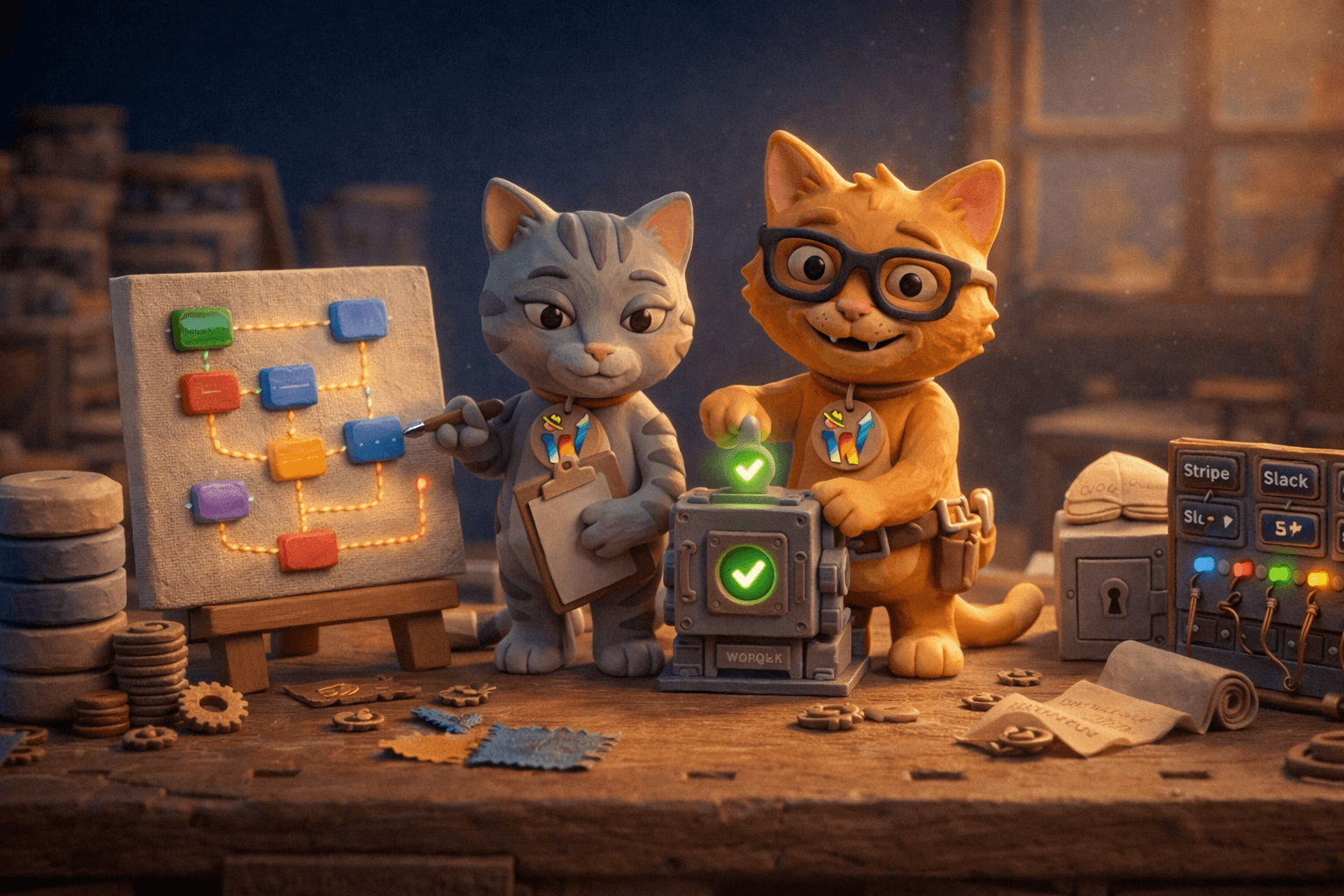
We rebuilt the core. Not a rebrand. The kind of changes that separate "cool demo" from "running in production."
Workflows that actually think. Branching, loops, conditionals, error handling, retry logic. What used to take JavaScript and CI/CD is now blocks on a canvas. Connect the pieces, watch it run, see exactly where it breaks. We spent months making it visual and debuggable without making it toy-like. The PM who can describe the workflow can build it. No ticket. No three-week wait.
An AI that builds, then proves it works. WorqHat's AI builds on the platform, not code you deploy. You describe what you need; it builds tables, charts, filters. Then it auto-runs tests. It verifies connections, validation, endpoints, UI. If something's broken it fixes it before you see the error. The difference between "AI that generates code" and "AI that generates working, tested applications" is the difference between a demo and a product. We're building the product.
Your own database. Zero setup. Real database, real scale. Schema visual or AI-inferred. Migrations and indexing automatic. No connection strings, no RDS, no DBA. You build a form; the database exists. The last 10% that used to force an engineering dependency is gone.
Integrations that just connect. Stripe, WhatsApp, Slack, email, SMS, webhooks. One click. No API wiring, no env vars, no 40-page docs. You say "when this form submits, charge via Stripe, notify Slack"; that sentence is the implementation.
Enterprise controls from day one. Where does our data live? Who can access what? Audit logs? Granular permissions? Self-host? SSO? Encryption? Data isolation? Every company with 200+ employees asks. Most platforms punt. We built RBAC, full audit logs, data isolation, self-host options, SSO, encryption, compliance tooling. All live now. Table stakes.
The enterprise focus (it's not "we added SSO")
Who needs WorqHat most? Companies where the PM needs a CRM, ops needs a support dashboard, finance needs an approval workflow, and all three are in the engineering queue. Every company has 20+ internal tools. Each one is at least two weeks of developer time. That's 40+ weeks a year on tools that aren't the product. WorqHat turns each into a two-day project for the person who understands the workflow. Build 20 tools per year at 2–3 weeks each and you're spending $50K–200K on internal tooling. WorqHat replaces that with a subscription.
The flywheel
The platform gets smarter with every workflow builders create. More builders, smarter AI, faster building, more builders. Lovable and Cursor can't do this; they're generic or IDE-bound. Retool still needs developers. We learn from every workflow that runs. Four layers: visual builder, AI generation, auto-testing, enterprise controls. Skip one and you have a demo. Include all four and you have a system that compounds. "It Always Takes Two" is how the platform works. Builders make it smarter; it makes builders faster. Neither player wins alone.
What happens next
You'll hear from us regularly. Not on a rigid schedule, but consistently enough that you'll know we're still building and still paying attention.
If you're already on WorqHat, keep building. The platform is better than it was last month. It'll be better next month than it is now. That's the whole point. That's the co-op game working as designed.
If you're not on it yet, come try it. Drag some components. Let the AI wire up the backend. Watch it auto-test itself. See if it clicks. And if something doesn't work the way you expect, tell us. That's how this gets better. That's how the two-player game progresses.
If you're an enterprise team drowning in internal tools backlogs, talk to us. Not because we have a slick sales deck (we don't). Because we have a platform that's already doing what your team needs, and the enterprise controls your procurement team requires.
Either way, we're in this together.
Sagnik
P.S. Pumpkin walked across my keyboard while I was writing this. He added "jjjjjjjjjjj" to the draft. Classic Pumpkin move. I removed it, but I thought you should know he tried to contribute. Olive watched from across the room and did nothing to stop him. Co-op at its finest.
Written by
Sagnik Ghosh
Created At
Wed Feb 11 2026
Updated At
Thu Feb 12 2026